How Gorillas Raise Their Young in Natural Habitats.
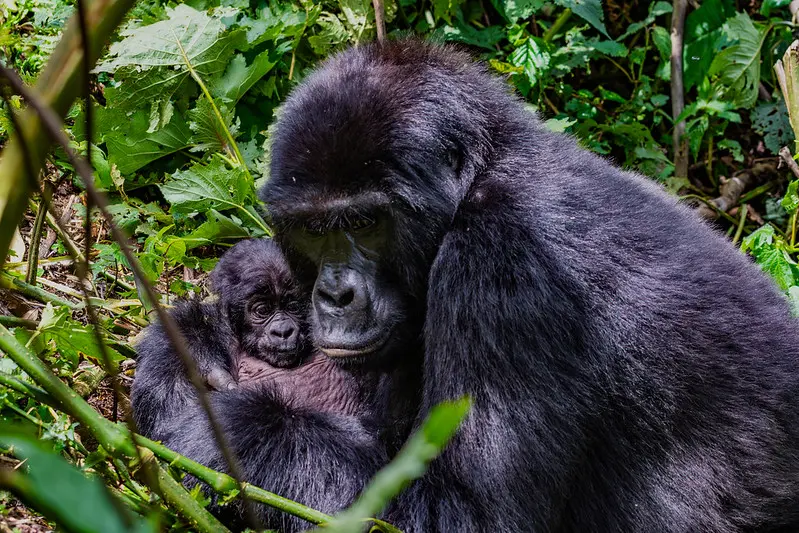
How are baby gorillas raised? Baby gorillas when produced are small in size, weighing between 1.4 and 1.8 kilograms, and are so fragile. These gorillas have a fast growth rate and reach maturity at a steady speed. Females reach maturity at 10 years, while males reach maturity at 13 years. Baby gorillas are raised in a way that mothers get close physical contact for the first five to six months after birth. This is done to ensure the safety of the infants. During the growth stage, mothers look out for the playful and moving stage, which provides comfort for the babies.
In three months after birth, baby gorillas start to manipulate objects in their environment. At 8 months, they get used to the environment and start walking through the jungle a few meters away from their mothers. With time, they become independent and start learning new tactics from their elders. During the day, baby gorillas are always eating and taking a rest, while in the night, they sleep in nests that are built on trees.
When baby gorillas are produced, it is said that they do not know who their real father is because a gorilla family can have more than one silverback. Sometimes a female may have mated with a member from a different gorilla family, making the baby gorilla more familiar with other silverbacks than his biological father.
How long do baby gorillas stay with their mother
Baby gorillas are young endangered mountain gorillas. They spend more time with their mothers breastfeeding in the first three months. They share 98% DNA with that of humans, making them unique creatures. Baby gorillas stay with their mothers for 3 to 4 years since their mothers keep a close eye on them and teach them skills like climbing on their mothers’ backs.
Newborns, immediately after birth, have their mothers take full responsibility to take care of them, and this lasts for two to three years when they have adapted to certain skills without their mothers’ watch. After these years, gorilla babies start to build their own lives, like walking on their legs and arms and nest building, among others. Here silverbacks also take full responsibility for protecting and guiding their babies.
When the gorillas fully mature, they develop features like wide chests, long arms, strong muscles, and others. They start feeding on various plant species like stems, roots, leaves, and fruits.
At what age do gorillas become adults?
Gorillas reach full maturity at the age of 12 to 15 years as they develop different characteristics in terms of strength and size.
Male gorillas, once they reach maturity, show signs of sexual maturity at 13 years, while the females show maturity signs at the ages of 10 to 12 years.
How many gorillas live in a group
Gorillas are the largest primates on planet Earth due to their strength and intelligence. They live in groups called troops and are usually led by a dominant silverback. The number of gorillas that live in a gorilla family depends on the species, social interactions, and habitat. Some gorilla groups have 5 to 10 individuals; other gorilla families have 30 individuals. Mountain gorillas have an average of 15 individuals. Western lowlands have an average of 8 members, eastern lowland gorillas have an average of 10 individuals, and cross-river gorillas have an average of 7 individuals per group.
What happens when a silverback dies
Silverbacks are male mountain gorillas that are strong and known for their leadership qualities. Silverbacks head the gorilla families, hence giving them a sense of direction. What makes a silverback is the grey hair on its back and its strength. It is characterized by the ability to protect and guide the gorilla families. Different reasons result in the death of silverbacks, like natural causes, predator attacks, or even fighting to save their family. The following happens when a silverback has died:
Some families scatter, losing a sense of direction, hence meandering through the forest as loners. Family individuals join other groups, especially the females. In case the family had other males, the young males take over the leadership; sometimes the silverbacks’ sons take over leadership.
Other silverbacks of a certain family will take over the leadership by force. In most cases, the family that has lost the silverback remains as it is without joining other families.
How similar are gorillas to humans
Humans are said to be more similar to the African great ape than any species in the world. Genetically, humans share 99% of their DNA with the chimpanzees. The chimps are mostly human, but genetics change. Whereas for mountain gorillas we share 98% of our DNA.
Humans and primates and chimpanzees all share the same ancestors and are closely related on the tree of life. And this can be determined temporally and genetically. And for this reason, our ancestors split from chimpanzees, our close relatives from bonobos, and humans diverged from gorillas years ago.
Researchers proved that the gorillas’ genes can help the animal’s skin grow a touch layer of keratin. This protein helps the gorillas develop fingernails and knuckles that aid the animals’ walking styles, which are absent in humans.
Can gorillas learn sign language?
Researchers have shown that some gorillas have used American sign language with sign phrase lengths of over eight signs and structured grammar. This was done for two reasons: differences in physical anatomy between the humans and gorillas and expressing changes in emphasis and feeling.
Are gorillas smarter than chimpanzees
Chimpanzees are smarter compared to gorillas. Despite the small sizes of the chimpanzees, they have bigger brains compared to those of mountain gorillas.
In conclusion, compared to the life span of both gorillas and chimpanzees, chimpanzees kept in captivity live between 50 and 60 years, while gorillas kept in captivity live between 45 and 60 years.