How Mountain Gorillas Differ from Lowland Gorillas.
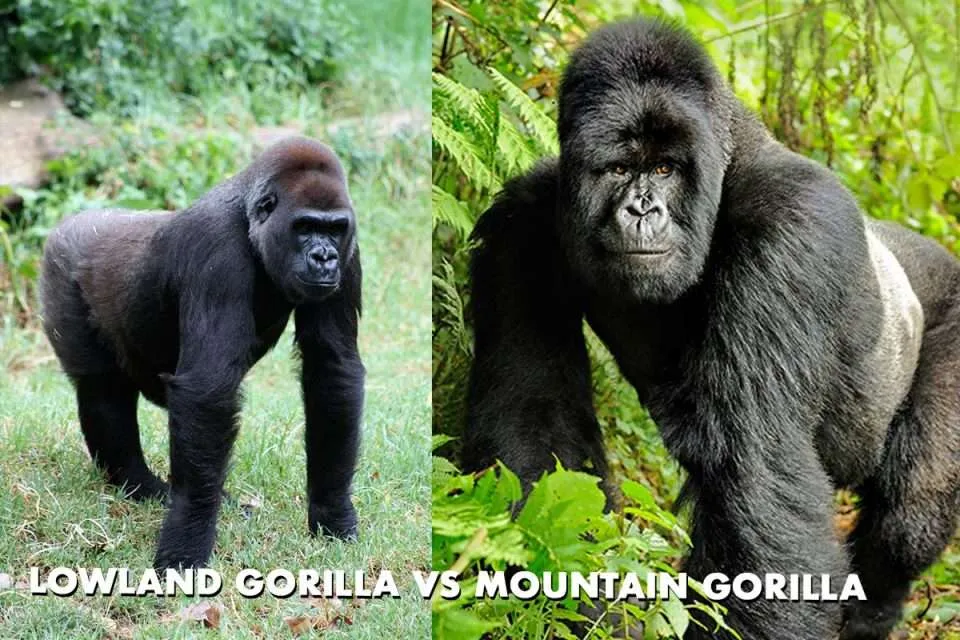
Differences Between Mountain Gorillas and Lowland Gorillas: Mountain gorillas and lowland gorillas both live and thrive in different environments. The differences range from behavior to habitat and morphology.
Lowland gorillas live in the dense tropical rainforests, since they survive in areas with low altitude, like forests and swamps. Mountain gorillas live in areas with high altitude in parts of Uganda, Rwanda, and the Democratic Republic of Congo. In Uganda, they are found in Bwindi Impenetrable National Park and Mgahinga National Park.
Mountain gorillas are few in number, and they are strong and big compared to the lowland gorillas. Mountain gorillas have wider faces while lowland gorillas have narrow faces.
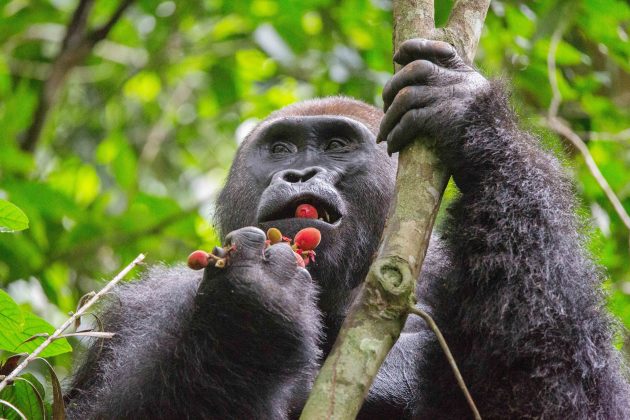
Both mountain gorillas and lowland gorillas are led by the silverback. While mountain gorillas are terrestrial, on the ground feeding on leaves, stems, and roots, lowland gorillas spend much of their time in trees and mostly feed on fruits.
Mountain gorillas have shorter limbs and broad chests and thick muscles compared to lowland gorillas. They grow longer and shaggier hair, which helps them regulate the cool temperatures in the forest. Their hair appears very dark on the shoulders, arms, and back.
Lowland gorillas are taller, with adult males being approximately 1.8 meters and 210 kg depending on the feeding and age. They have longer limbs and shorter hair length with a greyish and brownish color. Some gorillas have a light pigmentation around the eyes and nose. They have angular faces and slightly protruding mouths.
Mountain gorillas live in groups of 10 to 15 individuals and can reach about 30 individuals in a troop. The group is governed by the silverback, which decides when to hunt for food.
Lowland gorillas have 15 to 25 individuals in the troop. They have strong social bonds and are more flexible. Some groups form smaller individuals of about 5 to 8 members with weak cohesion. These groups are also led by the dominant silverback, which takes on leadership.
Mountain gorillas are herbivorous and mainly feed on leafy plants, succulent stems, and roots. Due to the high altitudes, their access to fruits is lower, making them feed mostly on succulent plants.
Lowland gorillas have a wide range of food to feed on. Their diet consists of fruits, termites, and plant species.
Both mountain gorillas and lowland gorillas communicate through facial gestures, use of low grunts, and dominant movements.
Where do gorillas live in the world?
There are four subspecies of gorillas in the world: western lowland gorillas, eastern lowland gorillas, Cross River gorillas, and mountain gorillas. Their living habitats differ according to their species.
Eastern lowland gorillas
Eastern lowland gorillas live in the countries of Rwanda, Uganda, and the Democratic Republic of Congo.
Western lowland gorillas
Western lowland gorillas live in the countries of Cameroon, Gabon, Congo, Central African Republic, Angola, and Nigeria. In the western lowland gorillas there are two subspecies, which include western lowland and Cross River gorillas. Cross river gorillas live around the border of Cameroon and Nigeria.
Mountain gorillas live in the volcanic mountains in the countries of Uganda and Rwanda, among the Virunga National Park and Bwindi Impenetrable National Park.
They are also captive gorillas, which are western lowland gorillas that live in zoos in the countries of the USA and Europe.
What do gorillas eat?
Mountain gorillas are the endangered species close to human beings that can be seen on the African safaris. In Bwindi National Park, there are about 400 endangered species. Tourists wonder what gorillas eat while in the jungle that makes them strong. Their feeding routine consists of succulent stems, buds, leaves, roots, and sometimes fruits. They consume food two times a day, in the morning and evening. They leave their shelters and are led by the silverback to hunt for food. Each gorilla family feeds on a different zone, and it is rare for them to enter different territories.
How they collect their food
Mountain gorillas are strong primates that use their strength to break branches and plants. They do not clear the vegetation in the area they feed on since they rotate around different areas looking for food. They are selective about what they feed on, as on some plants they only consume roots, while on other plants they consume stems only.
How much do they consume
Mountain gorillas consume about 20 kilograms daily since they have large body sizes and are used to producing more energy. They mostly consume succulent plants since water sources are unavailable in the mountainous areas. Silverbacks consume twice as much as other gorillas, hence acquiring more energy. One silverback can eat approximately 27 kilograms of food daily.
How long do gorillas live?
Mountain gorillas are some of the tourist attractions in Uganda found in both Bwindi Impenetrable National Park and Mgahinga National Park. The question is how long gorillas live.
It depends on their life span; gorillas can live for more than 35 years or less, and female gorillas live longer than males. As mountain gorillas clock 35 years, they are prone to respiratory diseases and various illnesses that damage the limbs, affecting their movements. Some of the difficulties they face are some losing their teeth, affecting the rates at which they consume food. They become less energetic. While the elderly gorillas are prone to diseases, the young gorillas are also prone to diseases like tuberculosis, hepatitis, and tapeworm infections.
Other facts include poaching by humans reducing the population of gorillas. Habitat destruction resulting in displacement. Therefore, increasing the population of gorillas is through emphasizing conservation guidelines that protect the gorillas as well as the tourists.
In conclusion, tourists should plan their safari in Uganda to experience how gorillas eat and the food they consume. Through the treks, rangers show you the different plant species they consume.